Notice: I have written in other languages, many interesting articles that you
can read translated in English in this
link.

Showing posts with label Hinduism. Show all posts

FABLE ABOUT THE GODDESS LAKSHMI

 
(This is chapter 8 of the Nicholas Roerich's book Shambhala.)


LAKSHMI, THE VICTORIOUS
 
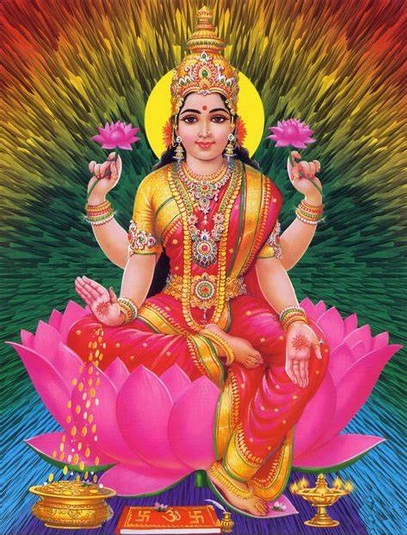
To the east of the mountain Zent-Lhamo, in a resplendent garden, lives the Blessed Lakshmi, Goddess of Happiness. By unending toil she beautifies her seven veils of peace. This is known to all men. All men pay reverence to the Goddess Lakshmi!
 
But all fear her sister, Siva Tandava. She, the Goddess of Destruction, is full of malice, terrible and destructive.
 
From behind the mountains came Siva Tandava herself. The terrible one went straight toward the dwelling of Lakshmi. Cautiously the terrible goddess approached the palace of Light and lowering her voice, called out to Lakshmi.
 
Lakshmi laid aside her precious veils and came forth to meet her. And behind her walked her maidens, full-breasted and round of hip.
 
Lakshmi, walking, disclosed her body. Large were her eyes, her hair was dark. Her armlets were golden. Her many necklaces were of pearls. The nails of Lakshmi were of the color of amber. Over her breasts and shoulders, and on her abdomen and down to her feet were poured unguents of special sacred herbs. Lakshmi and her maidens are as sparklingly pure as the images of the Temple of Mathura after the storm.
 
But all righteousness became stricken at sight of the dreaded Siva Tandava, so terrifying was she even in her apparent humility. From out her canine jaw were thrust threatening fangs. So red was her body and so shamelessly hirsute, that it was indecent to look upon. Even the armlets of blood-red rubies could not beautify Siva Tandava. One might even imagine her a man.
 
 
The Terrible one spoke:
 
-        ‘‘Hail to you, Lakshmi, righteous one, my near one! Much happiness and welfare hast thou created. Even too zealously didst thou perform thy work. Thou adornest temples with gold. Thou enrichest the earth with gardens. Thou Protectress of Beauty!
 
Thou hast created the rich and the generous. Thou hast created the poor, unreceiving yet rejoicing. Thou hast ordained peaceful trade. Thou hast planted among men all ties called benevolent. Thou hast conceived of joyous frail distinctions for man. Thou hast filled the hearts of people with the joyous realization of their superiority and pride. Thou art generous!
 
Thy maidens are tender and caressing. Thy youths are strong and aspiring. Joyously, people create according to their own likeness. People forget about change and destruction. Hail to Thee!
 
Calmly you observe the human procession. And there is little left for Thee to do! I worry over thee, my near one! Without labor, without worries, thy body will become heavy. And the precious pearls will fade upon it. Thy face shall shine and thy lovely eyes shall become bovine.
 
Then will the people forget to bring pleasant offerings for Thee. They will bring sacred flowers no longer. And you will no longer find any excellent workers for Thyself. All the sacred designs will become entangled. People cannot remain inactive. Here I am, full worrisome about thee, Lakshmi, my near one!
 
During long nights I have conceived a labor for Thee. We are akin to each other. Do not pay attention to the exterior. Hard is it for me to await the lengthy destruction of time. Let us unite and let us annihilate all human structures. Let us demolish all human joys. Let us eject all the foundations accumulated by men. Do not be so assured that people follow Thee. People dimly perceive the boundaries.
 
Tear down Thy seven veils of peace. And then I shall rejoice and at once accomplish my tasks, so that you may be aflame with zeal and creation. And again you shall shed benevolent tears over men and again you may weave still more ornamental veils for Thyself. You shall create still richer ornaments. You, the inexhaustible Giver! Again people will search for Thee.
 
In humiliation once more they will accept with gratitude Thy gifts. Thou shalt conceive for men so many small new conditions and petty inventions that even the most foolish will think himself clever and important. I do not fear the human curse and already perceive the joyous tears offered to Thee by men!
 
Ponder deeply, Lakshmi, my near one! My thoughts are useful to Thee and to me, Thy sister, they are full of joy.”
 
 
A cunning power has Siva Tandava. Only think! She recalled the past wars and human miseries. Only think! Again she wished to evoke upon earth the destruction through evil. Only think! What evil notions reawoke in this malicious brain.
 
But not one word did Lakshmi say in response. Silently, only by a gesture, she rejected the evil project of Siva Tandava.
 
Then once again the evil Goddess, ready with threats and grinding her fangs, and forgetful of all her previous benevolent approaches began:
 
-        “Foolish Lakshmi! You surround yourself with these peaceful female embroiderers. They cherish the small walls of their miserable homes. Bent over their earthly designs they forget to look at the stars. They forget the threatening conjunction of stars. People cannot grasp that which comes in peace. They revere the thunder and lightning.
 
Thy old altars are covered with fetid grease. Thy beauty cannot dwell in the dust of old houses. The best designs are destroyed by time and the best pattern is covered with mold. Follow me! I will show Thee such chorus of conceit that Thy wisdom shall be confounded!”
 
 
Such fearful things did Siva Tandava utter. And earthquakes pierced the earth with their convulsions. And islands sank into the oceans. And new mountains rose. But Lakshmi rejected all the offers of Siva Tandava.
 
The Blessed Goddess answered:
 
-        “To give you alone joy, and to cause men sorrow, I shall not tear my veils. With a delicate web shall I extol mankind. I shall gather from among all noble hearts, excellent workers. I shall embroider new signs on my veils! The most beautiful, the most precious, the most powerful. And in these signs, in the images of the noblest beasts and birds, in the outlines of flaming flowers and healing herbs, I shall send to the hearts of people my most benevolent invocations. I will evoke from the abyss the greatest creative fire. And with a rampart of flame will I safeguard the luminous strivings of the Spirit.”
 
Thus ordained Lakshmi.
 
 
Out from the resplendent Garden in defeat walked Siva Tandava. Rejoice, people!
 
Now shall Siva Tandava, in violent wrath await the long destruction of time. With incalculable ire, at times she crushes the earth and then hordes of people perish. But Lakshmi, ever in time, casts her blessed veils. And over the ashes of those who have perished, again men will gather.
 
They will meet in solemn procession.
 
The righteous Lakshmi adorns her veils with the new sacred signs. And from out the space she kindles a new Fire.


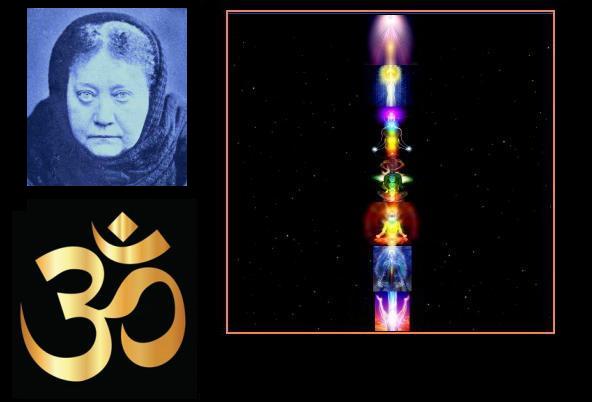
THE SEPTENARY STRUCTURE OF THE HUMAN IN HINDUISM EXPLAINED BY BLAVATSKY

 
In her great work The Secret Doctrine, Blavatsky explained that in India there are different classifications of the man composition, but these different classifications are esoterically based on the septenary classification.
 
 
« We give below in a tabular form the classifications adopted by the Buddhist and Vedantic teachers of the principles of man:
 

Classification in Esoteric Buddhism

Vedantic Classification

Ranking in Taraka Raja Yoga

7

Atma (Spirit)

Atma

Atma

6

Buddhi (Soul)

Anandamaya kosa

Karanopâdhi

5

Manas (Mind)

a) higher

Vijnanamaya kosa


Sukshmopâdhi

b) lower

Manomaya kosa

4

Kama Rupa (Desire)

3

Linga Sarira (Astral)

Pranamaya kosa


Sthulopâdhi

2

Prana (Vitality)

1

Sthula Sarira (Physical)

Annamaya kosa

 
a) Vigna nam.
b) Volitions and feeling, etc.
 
 
From the foregoing table it will be seen that the third principle in the Buddhist classification is not separately mentioned in the Vedantic division, as it is merely the vehicle of Prana. It will also be seen that the Fourth principle is included in the third Kosa (Sheath), as the same principle is but the vehicle of will-power, which is but an energy of the mind. It must also be noticed that the Vignanamaya Kosa is considered to be distinct from the Manomaya Kosa, as a division is made after death between the lower part of the mind, as it were, which has a closer affinity with the fourth principle than with the sixth; and its higher part, which attaches itself to the latter, and which is, in fact, the basis for the higher spiritual individuality of man.
 
We may also here point out to our readers that the classification mentioned in the last column is, for all practical purposes, connected with Raja Yoga, the best and simplest. Though there are seven principles in man, there are but three distinct Upadhis (bases), in each of which his Atma may work independently of the rest. These three Upadhis can be separated by an Adept without killing himself. He cannot separate the seven principles from each other without destroying his constitution.”
 
The student will now be better prepared to see that between the three Upadhis of the Raja Yoga and its Atma, and our three Upadhis, Atma, and the additional three divisions, there is in reality but very little difference. Moreover, as every adept in cis-Himalayan or trans-Himalayan India, of the Patanjali, the Aryasanga or the Mahayana schools, has to become a Raja Yogi, he must, therefore, accept the Taraka Raja classification in principle and theory whatever classification he resorts to for practical and occult purposes. Thus, it matters very little whether one speaks of the three Upadhis with their three aspects and Atma, the eternal and immortal synthesis, or calls them the “seven principles.” »
 
(SD I, p.157)


The number seven in the composition of the macrocosm
and of the man
 
And in an article that Blavatsky wrote, she gave more details on this topic.
 
« It is in the Upanishads and the Vedanta though, that we have to look for the best corroborations of the occult teachings. In the mystical doctrine the Rahasya, or the Upanishads — “the only Veda of all thoughtful Hindus in the present day,” as Monier Williams is made to confess, every word, as its very name implies (3), has a secret meaning underlying it. This meaning can be fully realized only by him who has a full knowledge of Prána, the ONE LIFE, “the nave to which are attached the seven spokes of the Universal Wheel.” (Hymn to Prána, Atharva-Veda, XI. 4.)
 
Even European Orientalists agree that all the systems in India assign to the human body: (a) an exterior or gross body (sthula-sarira); (b) an inner or shadowy body (sukshma), or linga-sarira (the vehicle), the two cemented with — (c), life (jiv or Karana sarira, “causal body”). (4)
 
These the occult system or esotericism divides into seven, farther adding to these — kama, manas, buddhi and atman.
 
The Nyaya philosophy when treating of Prameyas (by which the objects and subjects of Praman are to be correctly understood) includes among the 12 the seven “root principles.” (see IXth Sutra), which are:
 
1, soul (atman), and 2, its superior spirit Jivatman; 3, body (sarira); 4, senses (indriya); 5, activity or will (pravritti); 6, mind (manas); 7, Intellection (Buddhi).
 
The seven Padarthas (inquiries or predicates of existing things) of Kanada in the Vaiseshikas, refer in the occult doctrine to the seven qualities or attributes of the seven principles.
 
Thus: 1, substance (dravya) refers to body or sthula-sarira, 2, quality or property (guna) to the life principle, jiv; 3, action or act (karman) to the Linga, sarira; 4, Community or commingling of properties (Samanya) to Kamarupa; 5, personality or conscious individuality (Visesha) to Manas; 6, co-inherence or perpetual intimate relation (Samuvuya) to Buddhi, the inseparable vehicle of Atman; 7, non-existence or non-being in the sense of, and as separate from, objectivity or substance (abhava) — to the highest monad or Atman.
 
Thus, whether we view the ONE as the Vedic Purusha or Brahman (neuter) the “all-expanding essence;” or as the universal spirit, the “light of lights” (jyotisham jyotih) the TOTAL independent of all relation, of the Upanishads; or as the Paramatman of the Vedanta; or again as Kanada’s Adrishta, “the unseen Force,” or divine atom; or as Prakriti, the “eternally existing essence,” of Kapila — we find in all these impersonal universal Principles the latent capability of evolving out of themselves “six rays” (the evolver being the seventh).
 
The third aphorism of the Sankhya-Karika, which says of Prakriti that it is the “root and substance of all things,” and no production, but itself a producer of “seven things, which produced by it, become also producers,” has a purely occult meaning.
 
What are the “producers” evoluted from this universal root-principle, Mula-prakriti or undifferentiated primeval cosmic matter, which evolves out of itself consciousness and mind, and is generally called “Prakriti” and amulam mulam, “the rootless root,” and Avyakta, the “unevolved evolver,” etc.?
 
 
This primordial tattwa or “eternally existing ‘that,’” the unknown essence, is said to produce as a first producer, 1, Buddhi —“intellect”— whether we apply the latter to the 6th macrocosmic or microcosmic principle. This first produced produces in its turn (or is the source of) Ahankara, “self- consciousness” and manas “mind.”
 
The reader will please always remember that the Mahat or great source of these two internal faculties, “Buddhi” per se, can have neither self-consciousness nor mind; viz., the 6th principle in man can preserve an essence of personal self-consciousness or “personal individuality” only by absorbing within itself its own waters, which have run through that finite faculty; for Ahankara, that is the perception of “I,” or the sense of one’s personal individuality, justly represented by the term “Ego-ism,” belongs to the second, or rather the third, production out of the seven, viz., to the 5th principle, or Manas.
 
It is the latter which draws “as the web issues from the spider” along the thread of Prakriti, the “root principle,” the four following subtle elementary principles or particles — Tanmatras, out of which “third class,” the Mahabhutas or the gross elementary principles, or rather sarira and rupas, are evolved — the kama, linga, jiva and sthula-sarira.
 
The three gunas of “Prakriti” —the Sattwa, Rajas and Tamas (purity, passionate activity, and ignorance or darkness)— spun into a triple-stranded cord or “rope,” pass through the seven, or rather six, human principles.
 
It depends on the 5th —Manas or Ahankara, the “I”— to thin the guna, “rope,” into one thread — the sattwa; and thus by becoming one with the “unevolved evolver,” win immortality or eternal conscious existence. Otherwise it will be again resolved into its Mahabhautic essence; so long as the triple-stranded rope is left unstranded, the spirit (the divine monad) is bound by the presence of the gunas in the principles “like an animal” (purusha pasu).
 
The spirit, âtman or jivatman (the 7th and 6th principles), whether of the macro or microcosm, though bound by these gunas during the objective manifestation of universe or man, is yet nirguna — i.e., entirely free from them. Out of the three producers or evolvers, Prakriti, Buddhi and Ahankara, it is but the latter that can be caught (when man is concerned) and destroyed when personal.
 
The “divine monad” is aguna (devoid of qualities), while Prakriti, once that from passive Mula-prakriti it has become avyakta (an active evolver) is gunavat — endowed with qualities. With the latter, Purusha or Atman can have nought to do (of course being unable to perceive it in its gunavatic state); with the former —or Mula-prakriti or undifferentiated cosmic essence— it has, since it is one with it and identical.
 
 
The Atma Bodha, or “knowledge of soul,” a tract written by the great Sankaracharya, speaks distinctly of the seven principles in man (see 14th verse). They are called therein the five sheaths (panchakosa) in which is enclosed the divine monad—the Atman, and Buddhi, the 7th and 6th principles, or the individuated soul when made distinct (through avidya, maya and the gunas) from the supreme soul — Parabrahm.
 
The 1st sheath, called Ananda-maya —the “illusion of supreme bliss”— is the manas or fifth principle of the occultists, when united with Buddhi; the 2nd sheath is Vjnana-maya-kosa, the case or “envelope of self-delusion,” the manas when self-deluded into the belief of the personal “I,” or ego, with its vehicle. The 3rd, the Mano-maya sheath, composed of “illusionary mind” associated with the organs of action and will, is the Kamarupa and Linga-sarira combined, producing an illusive “I” or Mayavi-rupa. The 4th sheath is called Prana-maya, illusionary life,” our second life principle or jiv, wherein resides life, the “breathing” sheath. The 5th kosa is called Anna-maya, or the sheath supported by food—our gross material body.
 
All these sheaths produce other smaller sheaths, or six attributes or qualities each, the seventh being always the root sheath; and the Atman or spirit passing through all these subtle ethereal bodies like a thread, is called the “thread-soul” or sutratman.
 
We may conclude with the above demonstration. Verily the Esoteric doctrine may well be called in its turn the “thread-doctrine,” since, like Sutratman or Pranatman, it passes through and strings together all the ancient philosophical religious systems, and, what is more, reconciles and explains them. For though seeming so unlike externally, they have but one foundation, and of that the extent, depth, breadth and nature are known to those who have become, like the “Wise Men of the East,” adepts in Occult Science»
 
(Theosophist, July 1883, p.253-256)